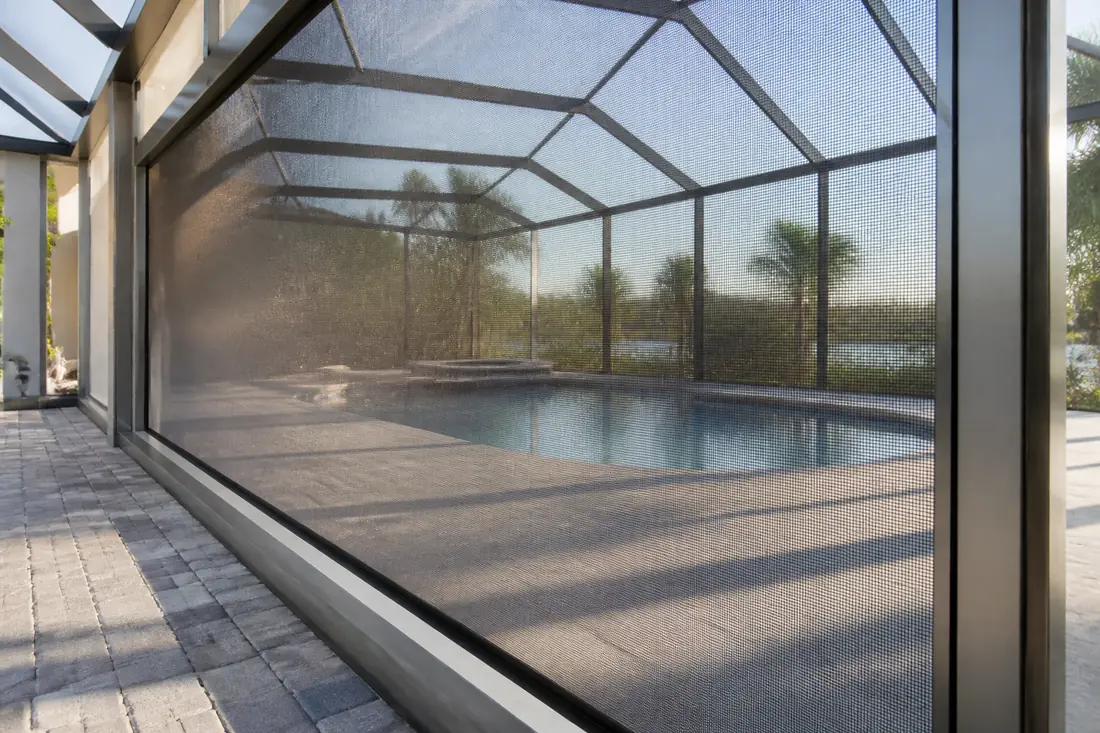
The mesh is the cheapest material in a screen enclosure and the one every quote gets compared on. Ask about a rescreen and the conversation turns almost immediately to the fabric — no-see-um, pet-resistant, solar, standard — as though the choice of weave is what determines whether you are doing this again in four years or fourteen.
It matters. It is not usually the thing that decides.
Screen panels in Sarasota rarely fail because the fabric wore out in the middle. They fail at the edges, at the fasteners, and at the frame — and they fail early when the enclosure around them has a problem the mesh was never going to solve. A rescreen fitted to a frame that is moving, or splined into a groove that is damaged, buys a fraction of the life the same mesh would give on a sound structure.
Which makes “how long will this last” a question about the whole enclosure rather than about the roll of material. Worth understanding before you choose, because the decisions that extend a rescreen’s life mostly get made before anybody picks a mesh.
Last reviewed: 10 September 2026 against the Florida Building Code, Building volume, 8th Edition (2023). Section numbers are from that edition; the Code is revised on a cycle and numbering moves, so confirm against the edition your jurisdiction has adopted.
The code has a specific mesh in mind
This is the fact that reframes the whole choice, and it is not what most people assume when they are choosing between quotes.
The Florida Building Code does not treat screen fabric as a finish. It treats it as a structural surface that collects wind load and delivers it to the frame. Table 2002.4 in Chapter 20 sets out design pressures for screen enclosures, and it specifies the mesh those pressures are based on: 20 × 20 × 0.013 inch. Twenty strands per inch each way, thirteen thousandths of an inch in diameter. The tabulated pressures run from around 4 to 66 psf depending on wind speed and exposure.
The significance is not the number itself. It is that the frame’s design assumed a particular fabric with particular porosity. A denser, less permeable mesh does not merely look different — it passes less air and therefore transfers more load into the same frame that was sized on the assumption of the code’s mesh.
That is the real trade-off behind the upgrade options, and it is rarely put to homeowners plainly. Tighter weaves keep out smaller insects and cut more glare. They also make the enclosure a better sail.
None of that makes them wrong. Specialty meshes are used on thousands of enclosures in this county and perform well. It means the choice belongs in a conversation about the structure, not just about insects — particularly on a large or tall cage, and particularly if the enclosure is at or near its original design limits already. The structural side of that question is covered in our guide to screen enclosure wind design.
The frame is the substrate
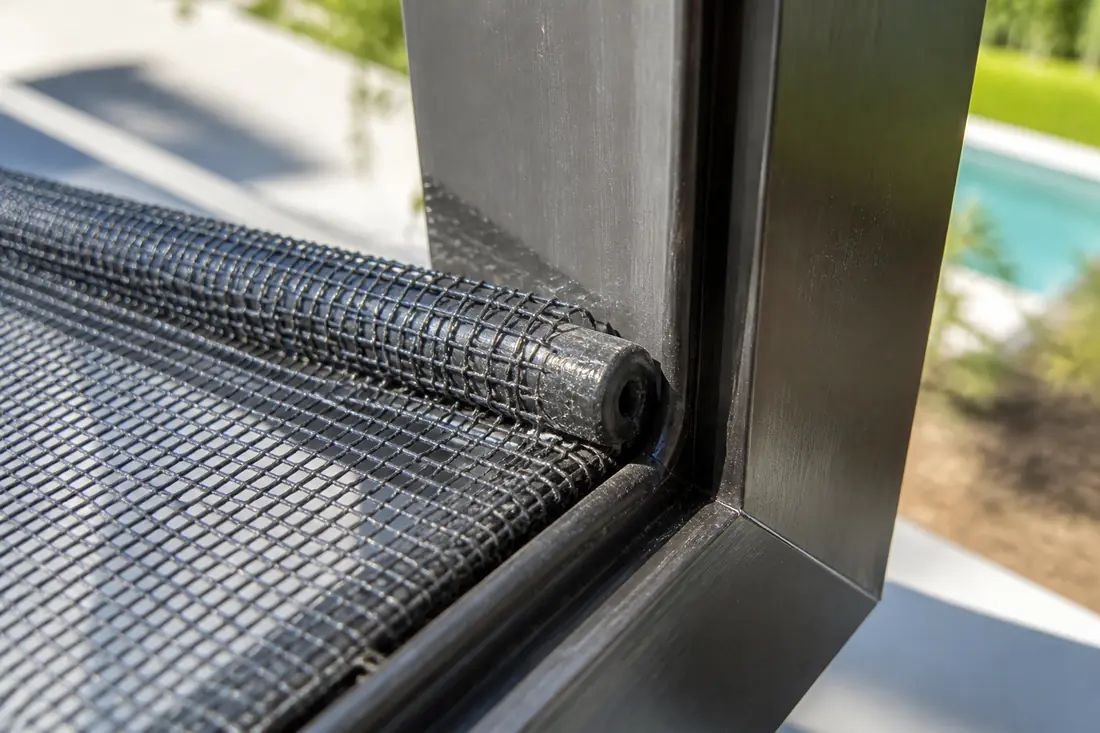
Screen is held in a groove by a spline — a flexible cord pressed in over the mesh to trap it. That joint is where nearly all early failures start, and it depends almost entirely on the condition of the aluminum.
Chapter 20 sets a floor for the members themselves. Section 2002.3.1 requires that “Actual wall thickness of extruded aluminum members shall be not less than 0.040 inch (1 mm).” Forty thousandths is not much metal, which is the point of the material — light, corrosion-resistant, and strong enough in the right section. It is also thin enough that a damaged groove does not recover.
What a professional is looking at, in the order it matters:
The spline groove. Splayed, dented or corroded groove walls will not grip a new spline properly. Screen fitted into a compromised groove pulls out at the corners within a season or two, and the failure looks like a mesh problem.
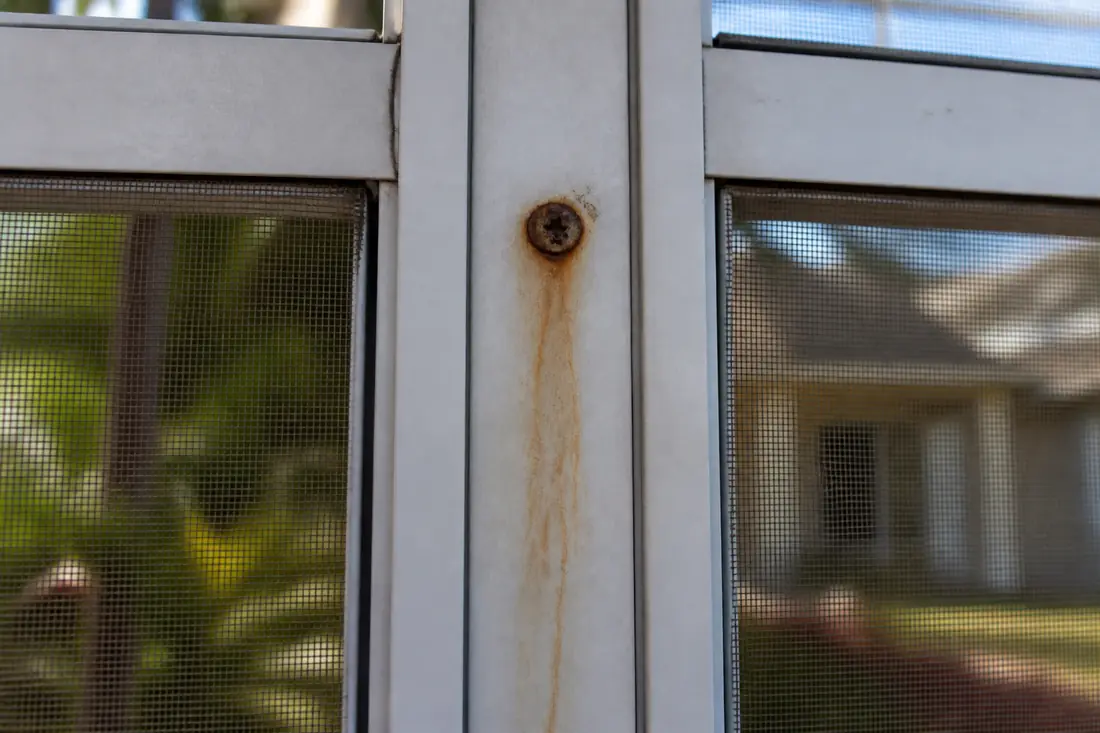
The fasteners. Screws at frame joints in salt air are the first components to go. Rust staining down a member from a joint is the visible symptom of a connection quietly losing strength.
Frame movement. A structure that racks slightly in wind works the mesh at every panel edge. Screen is strong in tension and poor at surviving repeated flexing at a fixed edge.
Standing water. Deck drainage that puts water at the base of uprights accelerates everything above.
What actually degrades the fabric
Where the mesh itself does fail, three mechanisms dominate on the Gulf coast, and they act on different parts of the enclosure.
Ultraviolet. The dominant one. It attacks the polymer coating on fiberglass mesh and embrittles it. South and west elevations go first, and the roof panels of a cage go before the walls because they take sun at a steeper angle for longer. This is why one panel can be brittle while the panel around the corner is fine — it is not a bad batch, it is a different exposure.
Mechanical fatigue at the edge. Wind cycles the panel, and the fabric works against the spline thousands of times. The failure appears as a tear starting at the frame rather than as general weakening.
Abrasion and impact. Vegetation touching a panel, furniture, animals, windborne debris. Highly local and usually obvious from the damage pattern.
Salt does relatively little to the mesh itself and a great deal to the metal holding it. On a barrier island property the frame and fasteners will normally set the replacement cycle long before the fabric does.
Screen fabrics are manufactured to a recognized standard — ASTM D3656 covers woven insect screening of this type, and the properties it tests include bursting strength, stiffness and color stability under accelerated weathering. The standard’s own values sit behind a paywall and are not quoted here; what matters for a buyer is that those three properties are the ones the industry measures, and they map neatly onto the three failure modes above.
Repair or rescreen the whole thing
The factors that push the decision each way.
Panel-by-panel replacement makes sense where damage is clearly localized and traceable to a cause — a branch, a ball, an animal; where the surrounding panels are still flexible and sound; and where the enclosure is relatively young.
A full rescreen makes sense where panels are failing in more than one place and more than one elevation; where the existing mesh has gone brittle enough that handling it during a partial repair damages the neighbors; where the cage is being worked on for other reasons and the access is already paid for; and where you want a single uniform appearance, since new mesh next to weathered mesh is visible.
The awkward case is a cage where the frame needs attention. Rescreening first and repairing the frame afterward means paying twice for the same panels, because frame work generally means removing screen. If both are needed, the order is frame then screen.
The removable panel rule, if you have solid panels
Many enclosures in this area include vinyl, tempered glass or acrylic panels — often a section of the lanai closed in for weather. Those are governed separately and the rule is easy to miss.
Section 2002.3.3 requires that “Vinyl, tempered glass, and acrylic panels shall be removable.” They must be identified as removable by a decal, and the decal “shall essentially state ‘Removable panel SHALL be removed when wind speeds exceed 75 mph (34 m/s).’” Decals must be placed so they are visible when the panel is installed.
This belongs in a piece about how long a rescreen lasts because of what happens when it is ignored. A solid panel left in place above 75 mph loads the frame in a way the design did not assume, and the frame is what your new screen is stretched across. A cage that racks slightly in a storm will not tear its mesh that day; it will hold panels out of square, and every spline groove in it works slightly differently from then on. That is a rescreen that starts ageing early.
So: if your enclosure has solid panels, somebody is expected to take them out ahead of a serious storm, which needs time and somewhere to store them. And if the decals are missing — which they often are on older installations, or after a rescreen where panels were refitted — the information that triggers the action is gone.
What drives the cost
There is no meaningful single price for a rescreen without knowing the panel count and sizes, the height of the cage, the mesh selected and the condition of the frame. What moves it:
- Panel count, not square footage. Labor is per panel — cut, position, spline, trim — so a cage of many small panels costs more than the same area in few large ones.
- Height and access. Roof panels and high wall panels need staging.
- Mesh selection. The material cost difference between standard and specialty mesh is real but usually smaller than people expect relative to labor.
- Frame remediation. Groove repair, fastener replacement or member replacement found during the work.
- Whether solid panels have to be removed and refitted.
Three mistakes worth avoiding
Choosing mesh before the frame is assessed. The substrate sets the service life, and a specialty mesh on a tired frame is money spent in the wrong place.
Upgrading to a denser weave without mentioning it to anyone. A tighter mesh changes the load the frame sees, and the code’s tabulated pressures assume the 20 × 20 × 0.013 inch fabric.
Rescreening in the wrong order. Frame work after new screen means removing what you just paid for.
Before you sign
Ask for the frame to be assessed before the mesh is chosen, and specifically for the condition of the spline grooves and the fasteners. Ask which mesh is being quoted and what its weave is. If you are considering a specialty mesh on a large or tall cage, ask whether it changes anything about the structure.
Then ask what the enclosure will need in five years, not this month. A rescreen is one part of the maintenance cycle of an aluminum structure in a marine environment, and the honest answer to how long it will last is a statement about the whole cage.
The sequence that saves money is frame first, mesh second — in that order, once.
This guide explains Florida Building Code requirements in plain language and is not legal advice. The edition adopted by your jurisdiction, and the building official’s determination for a specific property, control what is actually required.
Sources
- Florida Building Code, Building, 8th Edition (2023), Chapter 20 — Aluminum. Minimum extruded member wall thickness of 0.040 inch at Section 2002.3.1; removable vinyl, tempered glass and acrylic panels and the 75 mph decal at Section 2002.3.3; screen enclosure design pressures and the 20 × 20 × 0.013 inch mesh they are based on at Table 2002.4.
- Florida Building Code, Building, 8th Edition (2023), Chapter 16 — Structural Design. Ultimate design wind speeds from Figures 1609.3(1) through 1609.3(4), and their conversion to nominal design wind speeds at Section 1609.3.1 — the inputs that select a row from Table 2002.4.