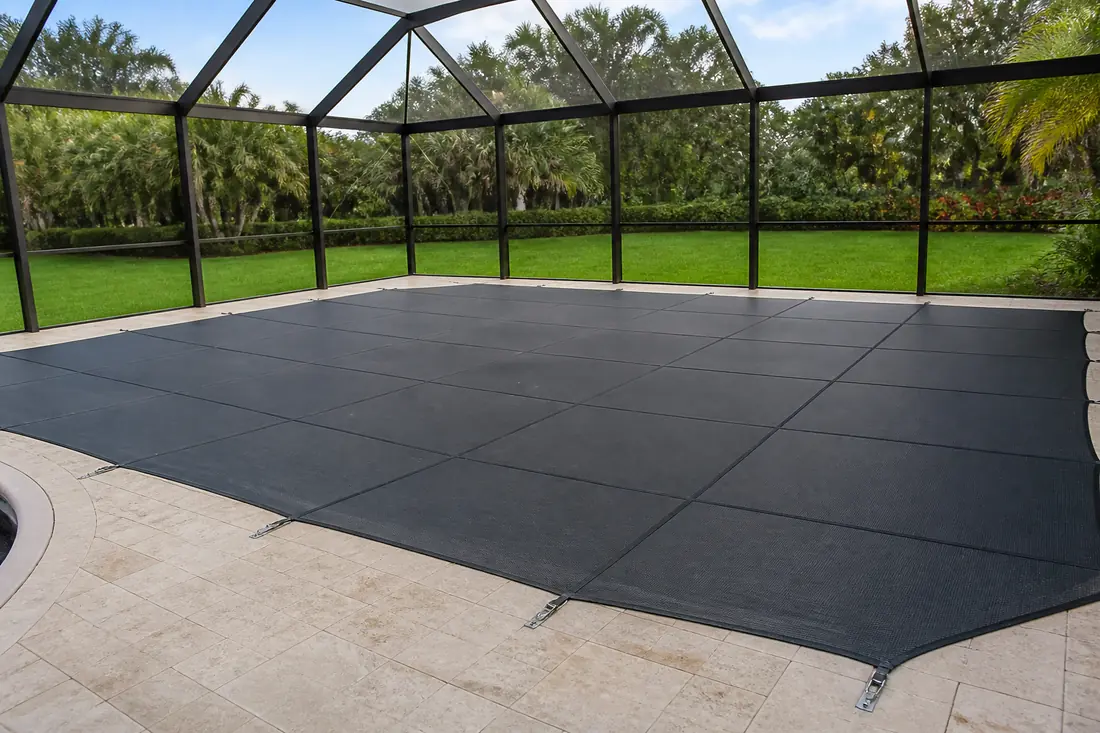
The question usually arrives in one of two ways.
Somebody is buying a house in Nokomis with a pool, no fence and no cage, and the inspector’s report says the pool barrier is non-compliant. Or a storm has taken the screen enclosure off a pool in Venice, the insurance adjuster has been and gone, and in the eight weeks before anything gets rebuilt there is a swimming pool in the back yard with nothing around it.
In both situations the same hope surfaces: that a cover will do. A cover can sometimes be fabricated and fitted faster than a permitted enclosure can be rebuilt, though timelines and pricing both turn on pool geometry, the anchoring substrate, permitting and whoever is making it.
The hope is also correct on the law. The Florida Building Code, Residential does contain an exception that removes the barrier requirement entirely, and a safety cover is it. There is exactly one, it is one sentence long, and it is the broadest exception in the chapter.
What it is not is a shortcut. The exception is written as though it describes a piece of equipment, and the standard it points to describes something closer to a habit. Everything difficult about choosing a cover over a cage lives in that gap, and it is not visible from the code text alone.
Last reviewed: 12 October 2026 against the Florida Building Code, Residential, 8th Edition (2023). Section numbers are from that edition. Sarasota County and the municipalities inside it adopt the Florida Building Code, but a code official’s determination for a particular property is what controls.
What the code asks for before the exception
Chapter 45 covers private swimming pools, and Section R4501.17 states the obligation in one line: residential swimming pools shall comply with Sections R4501.17.1 through R4501.17.3. Section R4501.17.1 then says outdoor pools shall be provided with a barrier complying with R4501.17.1.1 through R4501.17.1.14.
The chapter defines a barrier at R4501.2 as “a fence, dwelling wall or nondwelling wall or any combination thereof which completely surrounds the swimming pool and obstructs access to the swimming pool, especially access from the residence or from the yard outside the barrier.”
Read that definition slowly, because it contains the thing homeowners get wrong. A barrier is not a thing that stops people reaching the pool from the street. It is a thing that stops a child reaching the pool from inside the house. The code says so in the definition, and the sections that follow are built around that priority.
Then come fourteen subsections of geometry. The top of the barrier has to be at least 48 inches above grade, measured on the side facing away from the pool, with no more than 2 inches of vertical clearance between grade and the bottom of the barrier. Where the barrier sits on top of a pool structure, that clearance can be 4 inches. Openings must not allow passage of a 4-inch-diameter sphere. Where horizontal and vertical members are closer than 45 inches apart at the tops of the horizontals, the horizontals go on the pool side and the verticals are spaced no more than 1 3/4 inches apart; at 45 inches or more, the verticals can go to 4 inches. Chain link tops out at a 2 1/4-inch square mesh unless slats bring the opening down to 1 3/4 inches. Diagonal members are held to 1 3/4 inches.
Gates get their own paragraph. Self-closing, self-latching, latch on the pool side, and where the release sits at least 54 inches from the bottom of the gate it may be on either side. Nothing over half an inch may open within 18 inches of the release. Gates giving access to the pool open outward, away from the water.
That is a specification, not a suggestion, and it is why a cage rebuild on a screened pool is a permitted job rather than a weekend one.
The one sentence that removes it: an approved safety pool cover
Immediately beneath the compliance requirement, Section R4501.17 carries this:
Exception: A swimming pool with an approved safety pool cover complying with ASTM F1346.
Nine words of operative text. Note what it is attached to. The exception does not sit under R4501.17.1.1 or under the gate rules. It sits under R4501.17 itself, which is the section that invokes the whole run of requirements from R4501.17.1 through R4501.17.3. So the exception is not a relaxation of one dimension. It takes the barrier requirement off the table.
The term is defined back at R4501.2: “APPROVED SAFETY COVER. A manually or power-applied safety pool cover that meets all of the performance standards of ASTM International in compliance with ASTM F1346.”
Two words in that definition do a lot of work. “Manually or power-applied” means a hand-cranked cover and a motorized one are both eligible, which rules out the idea that this is a provision for expensive automatic systems only. And “meets all of the performance standards” is why a solar blanket, a leaf net, a winter tarp or a rollaway bubble cover is not what the code is talking about. Those products are not tested against F1346 and are not labeled to it.
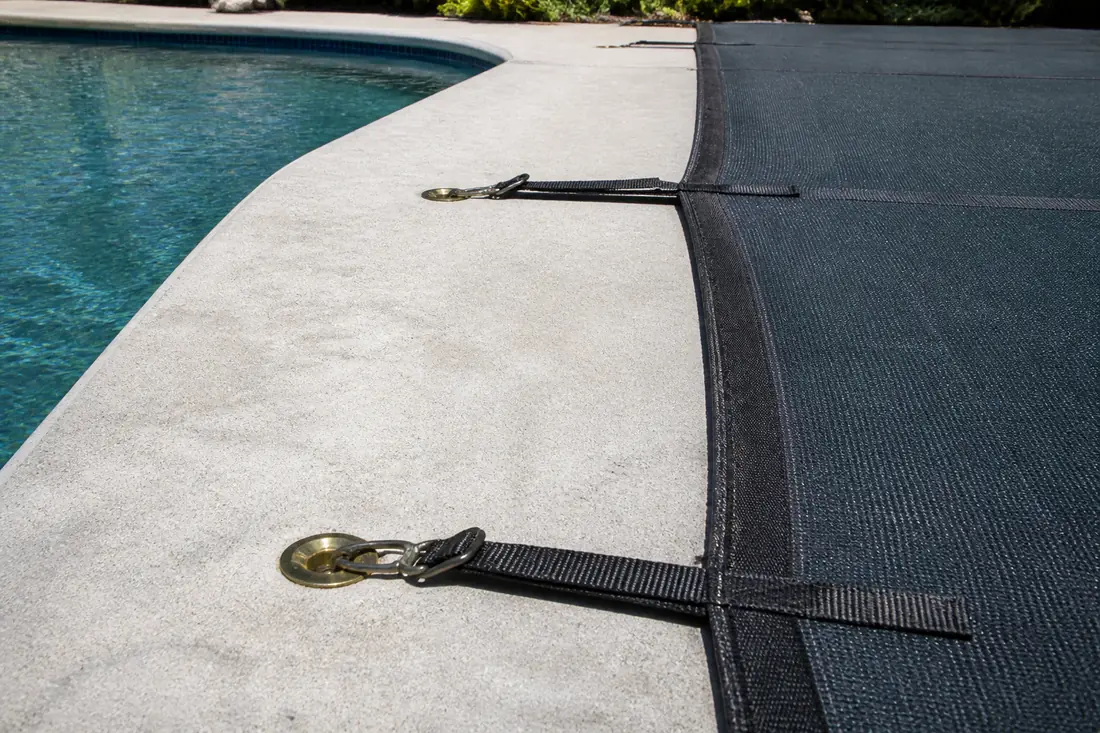
What ASTM F1346 actually governs
F1346 is titled “Standard Performance Specification for Safety Covers and Labeling Requirements for All Covers for Swimming Pools, Spas and Hot Tubs.” It is maintained by ASTM Committee F15, and the current active version is F1346-23.
The standard is behind a paywall, so nothing in this article quotes a test value from it. Its published scope is enough to make the point, and the scope is where the important sentence is:
When correctly installed and used in accordance with the manufacturer’s instructions, this specification is intended to reduce the risk of drowning by inhibiting the access of children under five years of age to the water.
The scope also states that the specification includes performance tests demonstrating compliance or noncompliance, and marking requirements that apply to all covers, not only safety covers. That last part is the reason a reputable pool cover carries a label about what it is and is not: F1346 governs labeling across the whole product category, and the non-safety products have to say so.
Now put the code sentence and the standard’s scope side by side. The code grants the exception to a pool that has an approved cover. The standard says the protection arrives when the cover is correctly installed and used per the manufacturer’s instructions.
That is the whole trade-off, and it is sourced rather than inferred. Every other compliance route in R4501.17 protects the pool whether anybody is paying attention or not. A cage protects it at 3 a.m. A fence protects it during a party. A cover protects it when it is on, drawn tight and latched to its anchors.
The five routes, and which of them need somebody
Chapter 45 offers more paths than most homeowners realize. Laid out, they are:
A conforming barrier. Fence, wall, or combination, built to the fourteen subsections above. Passive once it exists.
A screen enclosure. Section R4501.17.1.11 states that standard screen enclosures meeting the requirements of Section R4501.17 may be used as part of or all of the barrier, and that such an enclosure “shall be considered a ‘nondwelling’ wall.” Many pools in Sarasota County rely on that provision, and the site’s guide to your pool cage as the legal barrier covers what the cage has to do to qualify. Passive.
Removable mesh fencing. Section R4501.17.1.15 accepts a mesh safety barrier meeting Section R4501.17, installed per the manufacturer’s instructions and complying with ASTM F2286, the removable mesh fencing specification; its active version is F2286-16(2023). The same code section, not the ASTM standard, adds two conditions: a hinged gate used with a mesh fence has to meet the gate rules at R4501.17.1.8, and mesh fences “shall not be installed on top of above-ground/on-ground private swimming pools.” Passive while it is up, and the word “removable” is doing the same job there that it does on a cover.
A dwelling wall, with one of three protections. Section R4501.17.1.14 lets a wall of the house serve as part of the barrier where it has no door or window opening onto the pool. Where it does, R4501.17.1.9 gives three alternatives: exit alarms on all doors and windows with direct access, complying with UL 2017 and rated at a minimum sound pressure of 85 dBA at 10 feet with any deactivation switch at least 54 inches above the threshold; or self-closing, self-latching devices with positive mechanical latching installed at least 54 inches above the threshold on all doors with direct access, approved by the authority having jurisdiction; or a pool alarm independently certified to ASTM F2208. The section carries three exceptions for windows that are not a practical route: screened or protected windows with a sill at least 48 inches above the interior finished floor at the pool access level, windows facing the pool on a floor above the first story, and screened or protected pass-through kitchen windows 42 inches or higher with a counter beneath.
An approved safety cover. The exception. Active.
Four of those five keep working while everybody is asleep. One does not.
Sarasota’s own wrinkle: the water on the other side
There is a provision in this chapter that matters more here than it does inland. Section R4501.17.1.14.1 allows permanent natural or man-made features such as bulkheads, canals, lakes and navigable waterways adjacent to a pool to serve as a barrier when approved by the authority having jurisdiction.
The code then tells the official what to satisfy themselves about. The authority may perform on-site inspections and review surveys, aerial photographs, water management agency standards and other documentation, to verify at a minimum that the feature is not subject to natural changes, deviations or alterations and is capable of providing an equivalent level of protection to the code’s, and that it clearly impedes, prohibits or restricts access to the pool.
On a canal-front lot in Venice or a bayfront lot on Siesta Key, that is a live question rather than an academic one, and it is decided by a person rather than by a dimension. It is also the provision most likely to be misremembered by a seller as “the canal counts” — the canal counts when the building official says it does, on evidence.
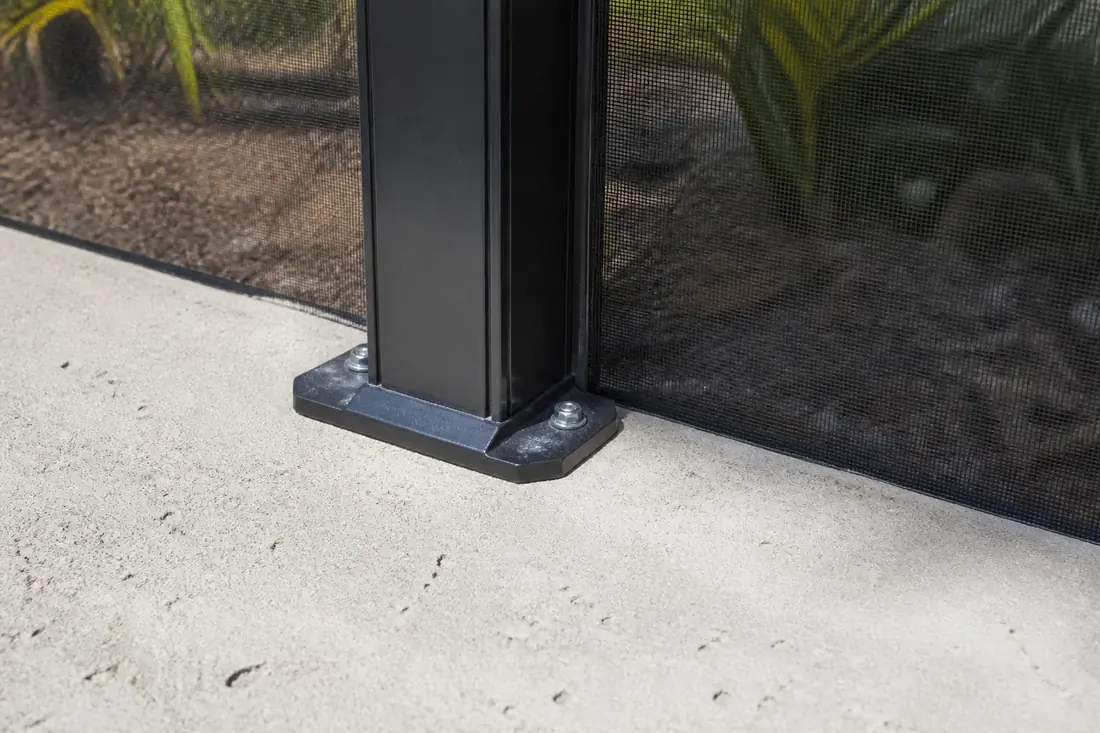
One related detail with real consequences for enclosure design: Section R4501.17.1.13 requires removable child barriers to sit at least 20 inches back from the water’s edge, and then carves out dwelling and nondwelling walls, screen enclosures included, which may be as close to the water’s edge as the code otherwise permits. A cage can be built at the coping. A removable mesh fence cannot.
How a professional sizes this up, in order
Someone evaluating a non-compliant pool does not start with products. The sequence runs roughly like this.
First, where are the openings from the house to the pool? Sliders, French doors, single-hung windows at deck level, a laundry door, a pet door. This decides whether the dwelling wall can be part of the barrier at all under R4501.17.1.14, and if not, which of the three R4501.17.1.9 routes is realistic.
Second, what already exists on the deck? A cage with a bent member and a torn panel is a compliance problem and a repair problem at the same time, and whether that work is a repair or an alteration changes what has to be brought up to current code; the site’s guide to where a repair becomes an alteration is the longer answer.
Third, what is the deck made of, and how thick is it? Cover anchors are set into the deck. Cage columns are bolted to it. Pavers over sand and a 4-inch slab are different substrates with different fixing details, and this is usually the item that moves a quote.
Fourth, what is the pool’s shape? A rectangle takes a cover well. A free-form pool with a raised spa, a sun shelf, a rock waterfall and a bench takes a custom-cut cover with more anchors, more seams and more opportunity for the cover not to sit tight. The code’s exception does not care about shape. The manufacturer’s instructions, which the standard’s scope makes load-bearing, very much do.
Fifth, who is going to be operating it? A code official has no reason to ask that one, because nothing in Chapter 45 makes it a condition of approval. It is still the question that decides whether the exception is a real solution for a particular household.
Cover or cage: what pushes the decision each way
A cover may make sense when the pool is a simple shape, when the deck will take anchors cleanly, when fabrication and permitting timelines for an enclosure would otherwise leave the pool non-compliant for a long stretch, when the household has no young children and no young grandchildren visiting, and when the people using the pool are the people who will close it. That timing question is worth confirming with the jurisdiction and the fabricator rather than assumed, because it moves.
A cage tends to make more sense when the house has multiple openings onto the deck, when there are small children in the household, when the pool is used daily in season and a cover would be off more than it is on, when the lanai is part of how the house is actually lived in, and when the owner wants the compliance question settled by structure rather than by routine.
There is also a non-code reason a great many Sarasota County pools end up under a cage, and it is honest to name it: the cage is doing several jobs at once. A cover has no view through it, keeps nothing out of the air above the pool, and does nothing about insects on the deck. Rescreening a pool cage and rebuilding one are different sizes of project, and both of them leave you with a room. A cover leaves you with a covered pool.
Neither is the right answer in general. The factors above are the answer.
What drives the cost of a cover versus a cage
There is no meaningful single price for either route without knowing the pool’s dimensions and shape, the number and type of anchors or columns the deck will accept, the deck material and thickness, whether existing framing or screen can be reused, whether the work triggers a permit and engineering, and what the structure has to be designed to resist.
What can be said usefully is where the money hides. On a cover: the cut, the number of anchors, and whether the deck needs remedial work before anything is set into it. On a cage: the structural design, the fixings at the base, and whether adjacent framing is sound enough to tie into. On either: the openings from the house, because if the dwelling wall cannot be part of the barrier, alarms or latching hardware are a separate line item that neither product includes.
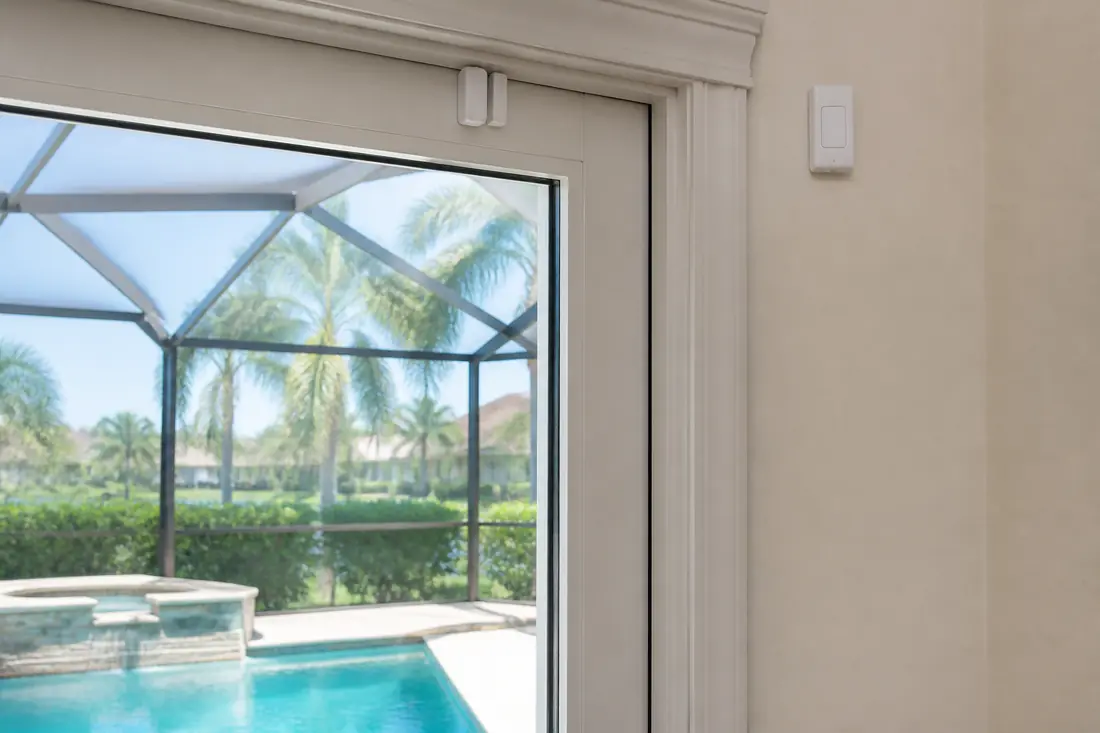
Be particularly careful with a quote that treats the barrier question as solved by the product alone. The barrier is a system that includes your sliding door.
Four mistakes worth avoiding
Treating a solar blanket as a safety cover. They look similar from the house and they are different products. The code’s exception is tied to compliance with ASTM F1346, and F1346 sets labeling requirements for all covers precisely so the distinction is visible on the packaging. If a cover does not say it complies, assume it does not.
Assuming the fence around the yard is the barrier. Section R4501.17.1.12 requires the barrier to be placed around the perimeter of the pool and to be separate from any fence, wall or other enclosure surrounding the yard, unless that enclosure or a portion of it sits on the perimeter of the pool, is being used as part of the barrier, and meets the barrier requirements. A privacy fence on the lot line usually fails all three tests at once.
Forgetting that an enclosure can be undone. A cage is passive, but a cage with a screen panel torn free at deck level has an opening in it, and R4501.17.1.2 does not distinguish between an opening that was designed and one that happened. After a storm, a structurally intact enclosure can still be a non-compliant barrier. Storm damage screen repair and barrier compliance are the same inspection on a pool deck.
Putting a barrier somewhere the code prohibits. Section R4501.17.3 states that a barrier may not be located in a way that allows any permanent structure, equipment or window that opens to provide access from the home to the pool. A barrier drawn around a pool pad so that the pump housing, a planter wall or a bedroom window ends up on the pool side of it has created the access it was supposed to obstruct.
Before you buy either one
Ask the contractor, in writing, which section of R4501.17 the proposed work is relying on. A quote for a cover should name ASTM F1346. A quote for a cage should address R4501.17.1.11 and the geometry in R4501.17.1.1 through R4501.17.1.8.
Ask what happens to the openings from the house. If the answer is nothing, ask which of the three options in R4501.17.1.9 is being relied on, or whether R4501.17.1.14 applies because no door or window opens onto the pool.
If a cover is being proposed, get the manufacturer’s instructions before you sign, not with the delivery. The standard’s own scope makes correct installation and use a condition of the protection, so those instructions are part of the compliance case rather than a leaflet in the box.
If the lot backs onto water and a seller or agent has told you the waterway serves as the barrier, ask for the building official’s approval in writing. R4501.17.1.14.1 makes that approval the operative fact.
And get the final inspection paperwork, whichever route you take. A pool barrier is one of the few things on a residential property where what was approved and what is there can drift apart over a decade without anybody noticing.
The sequence that saves money is to decide the route before pricing the product. A cover and a cage are not two prices for the same outcome. They are two different compliance strategies, one of which depends on a person and one of which does not, and that difference should be chosen deliberately rather than discovered in July.
This guide explains code provisions in plain language and is not legal advice or a code determination. The code edition adopted by your jurisdiction, and the code official’s determination for a specific property, control what is actually required. It is also not drowning-prevention advice: no barrier, cover, alarm or enclosure substitutes for supervision.
Sources
- Florida Building Code, Residential (2023), Chapter 45 — Private Swimming Pools. The definitions of “approved safety cover” and “barrier” at Section R4501.2; the compliance requirement and its sole exception for an approved safety pool cover complying with ASTM F1346 at Section R4501.17; the outdoor barrier requirement at Section R4501.17.1; the 48-inch height, the 2-inch and 4-inch bottom clearances at R4501.17.1.1; the 4-inch sphere and removable child barrier rule at R4501.17.1.2; the 45-inch horizontal member test and the 1 3/4-inch and 4-inch vertical spacings at R4501.17.1.4 and R4501.17.1.5; the 2 1/4-inch chain link mesh at R4501.17.1.6; the 1 3/4-inch diagonal opening at R4501.17.1.7; the self-closing, self-latching gate requirements, the 54-inch release height, the half-inch opening within 18 inches of the release and outward-opening gates at R4501.17.1.8; the three dwelling-wall alternatives — UL 2017 exit alarms at 85 dBA at 10 feet with a deactivation switch 54 inches above the threshold, self-closing self-latching devices at 54 inches, and an ASTM F2208 pool alarm — together with the 48-inch sill, upper-story and 42-inch pass-through window exceptions at R4501.17.1.9; the use of screen enclosures as part or all of the barrier and their treatment as a nondwelling wall at R4501.17.1.11; the perimeter and separate-from-yard-fence requirement at R4501.17.1.12; the 20-inch setback for removable child barriers and its carve-out for walls and screen enclosures at R4501.17.1.13; the no-door-or-window dwelling wall at R4501.17.1.14; the adjacent waterways provision and the evidence a building official may review at R4501.17.1.14.1; the ASTM F2286 removable mesh barrier route at R4501.17.1.15; and the prohibited locations rule at R4501.17.3.
- ASTM F1346-23, Standard Performance Specification for Safety Covers and Labeling Requirements for All Covers for Swimming Pools, Spas and Hot Tubs. The published scope, including the statement that the specification is intended to reduce the risk of drowning by inhibiting the access of children under five years of age to the water when the cover is correctly installed and used in accordance with the manufacturer’s instructions; that it includes performance tests demonstrating compliance or noncompliance; and that it sets marking requirements for all covers. Also the committee (F15) and the active version, F1346-23. The full standard is behind a paywall and no test value from it is quoted here.
- ASTM F2286, Standard Design and Performance Specification for Removable Mesh Fencing for Swimming Pools, Hot Tubs, and Spas. The published scope — performance and design requirements for removable mesh safety barriers, to reduce the incidence of injuries or death for children up to and including five years of age — and the active version, F2286-16(2023). Cited for what the standard the code references governs; its contents are paywalled and not quoted.